Volume 20, Issue 3 (September 2023)
Abstract
(19680 Views) |
Full-Text (PDF)
(8295 Downloads)
|
Graphical Abstract
|
Reseach Highlights
Graphical Abstract:
Reseach Highlights:
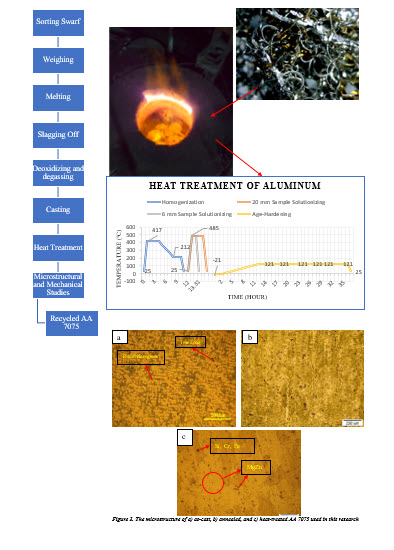
1. This study first aims to evaluate feasibility of recycling 7075 Aluminum Swarf and then assess the mechanical and microstructural properties of Recycled 7075 Aluminum Swarf.
2. After pressing in a cylindrical mold, the AA 7075 alloy swarf was melted and cast in a wet sand mold, in a controlled process to limits the defects and degassing.
4. non-aluminum elements such as impurities can be reduced by Martini N71P degasser tablets wrapped in aluminum foil and by holding it at the bottom of cast to complete the deoxidation and degassing process.
3. The sheets after homogenization were solutionized and aged at 485°C and at 121 ° C for 30-90 minutes and 24 hours, respectively.
5. The recycled 7075 aluminum alloys can be recovered, using swarf aluminum alloys as raw material. After homogenization, solutionizing and aging treatment, the recycled 7075 aluminum alloy have more uniform composition distribution, finer grain and better microstructure.
6. Microstructural and mechanical studies showed promising features regarding the recycling of AA 7075 swarf.
Abstract
(24776 Views) |
Full-Text (PDF)
(8313 Downloads)
|
Graphical Abstract
|
Reseach Highlights
Graphical Abstract:
Reseach Highlights:
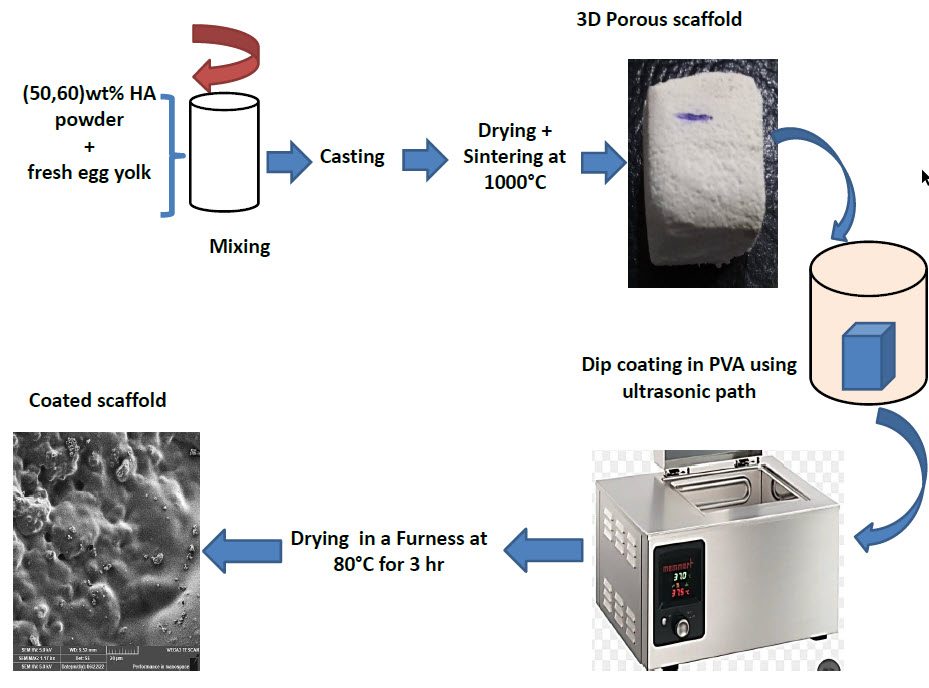
PVA Polymer coating process for Hydroxyapatite scaffolds leading to reinforced scaffolds by doubling the compressive strength as a result of decreasing porosity to the rate of 18% and cracks blocking.
- After polymer coating, there was a reduction in surface roughness and wettability.
- All scaffolds which were fabricated for the purpose of the present study have compressive strength in the range of trabecular bone strength. This reflects a good suitability for non-load bearing applications.
Abstract
(21432 Views) |
Full-Text (PDF)
(9203 Downloads)
|
Reseach Highlights
Reseach Highlights:
- Creating copper red glaze under normal sintering conditions
- Using SiC as reducing agent.
- Using the DSC method to analyze the physicochemical processes of glaze
Abstract
(23029 Views) |
Full-Text (PDF)
(8327 Downloads)
|
Graphical Abstract
|
Reseach Highlights
Graphical Abstract:
Reseach Highlights:
Highlights
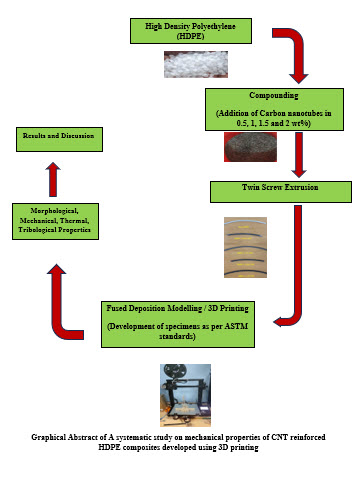
Our work aims to find new novelty as bulk amount of research has been carried out using conventional manufacturing techniques for enhanced improvement of mechanical, thermal properties of CNT/HDPE based polymer nanocomposites but the use of latest manufacturing technology by 3D printing (FDM) process has been scarcely reported knowing the advantages of the process.
In this work, HDPE/CNT composites were developed using twin screw extrusion and FDM 3D printing processes. The effect of addition of CNTs in varying weight percentage to the HDPE matrix was evaluated by conducting microstructural, surface roughness, impact, and tensile studies.
- Microstructure analysis using SEM showed uniform dispersion of CNTs and with increase in CNT content revealed no agglomeration. The interfacial bonding between CNT and HDPE matrix was found to be continuous and free from defect.
- Surface roughness studies showed decrease in Ra value as the CNT content was increased in the HDPE composites. The lowest surface roughness was recorded for HDPE/2.0%CNT composite. The reduction in volumetric change in HDPE polymer chains and diminishing of thermal gradients due to presence of CNTs helped the composites to overcome the dimensional inaccuracy related issues which in turn resulted in lower surface roughness values for composites.
- The HDPE composites showed increase in impact and tensile strength with the increase in CNT content. The better dispersion and good interfacial bonding of CNTs with HDPE matrix helped the composite to bear higher loads. The elastic modulus was also found to increase with CNT content with HDPE/2.0%CNT composite showing highest value of 1122.2 MPa.
- The fracture analysis using SEM showed brittle type of failure for all composites while neat HDPE showed ductile fracture. The fracture surface analysis did support the claims of uniform dispersion and alignment of CNTs in the printing direction.
Abstract
(19453 Views) |
Full-Text (PDF)
(8321 Downloads)
|
Reseach Highlights
Reseach Highlights:
Highlights:
- In this study, the Taguchi method was used for the optimization of the RFW process parameters following an experimental plan, after performing the tensile tests and collecting results in the pre-treatment phase.
- After processing and interpreting the recorded results, using statistical software for both the TiAl6V4 alloy and AA2024 one, regression models of the UTS were extracted and then optimized using an appropriate solver, which allowed us to obtain the best mechanical result, indicating satisfaction with the purpose of this work.
- Parameter which affects mostly the UTS value of the TiAl6V4 alloy is the rotational speed.
- The UTS of the AA2024 alloy is sensitive to each studied parameter of the RFW process, especially the friction time which has the most important effect.
Abstract
(25548 Views) |
Full-Text (PDF)
(8049 Downloads)
|
Graphical Abstract
|
Reseach Highlights
Graphical Abstract:
Reseach Highlights:
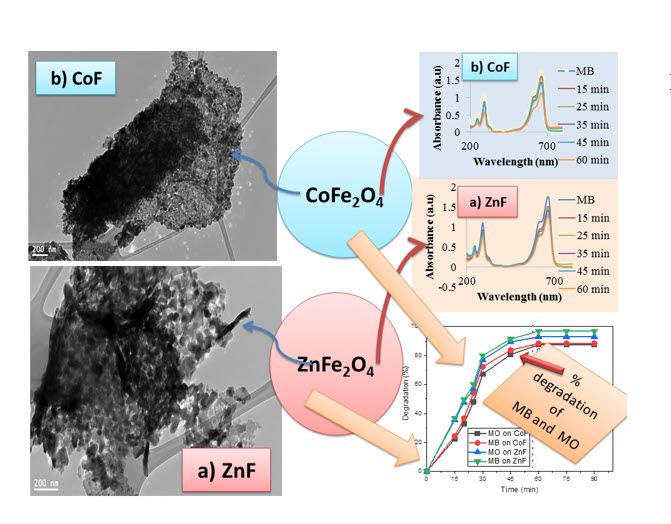
- CoFe2O4 and ZnFe2O4 photocatalysts were successfully synthesized and characterized by TEM, SEM, XRD, UV-vis, and EDS.
- The characterization results exhibited cubic nanostructures with particle sizes reaching 9 and 11 nm for ZnFe2O4 and CoFe2O4, respectively.
- CoFe2O4 and ZnFe2O4 exhibited high activity in the degradation of MB and MO dyes under sunlight within 60 min.
- The findings also showed that the ZnFe2O4 photocatalyst was more effective inthe degradation of dyes than the CoFe2O4 photocatalyst.
Abstract
(20444 Views) |
Full-Text (PDF)
(7786 Downloads)
|
Graphical Abstract
|
Reseach Highlights
Graphical Abstract:
Reseach Highlights:
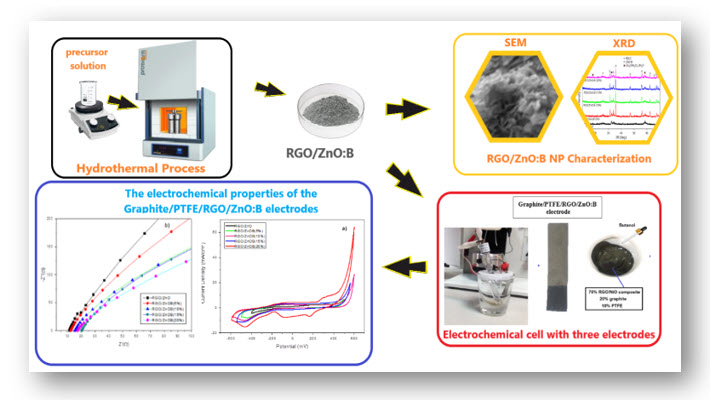
- RGO/ZnO:B composite materials were produced using the hydrothermal method.
- SEM images shows, the RGO/ZnO:B composites obtained consist of hexagonal plate and hexagonal rod mixtures.
- The structure of the RGO/ZnO:B composites was characterized as a wurtzite ZnO, a simonkolleite zinc hydroxide and RGO phase mixtures from the XRD spectrum.
- The electrochemical properties of the Graphite/PTFE/RGO/ZnO:B electrodes were examined using capacitance, impedance and charging/discharging curves.
- The performance of the capacitance increased four-fold with a 20% boron concentration.
- Electrodes with high boron concentration showed longer cycle performance.
Abstract
(20711 Views) |
Full-Text (PDF)
(7678 Downloads)
|
Graphical Abstract
|
Reseach Highlights
Graphical Abstract:
Reseach Highlights:
Highlights
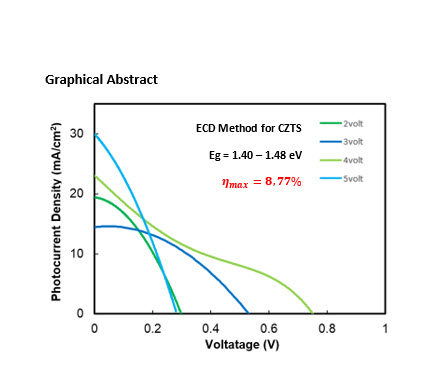
- Cu2ZnSnS4 thin film layer was fabricated by the electrochemical deposition method
- Voltage variation results in the kesterite band gap from 1.40-1.48 eV
- Solar cell performs an excellent efficiency of 8.77% via the non-vacuum process
Abstract
(23833 Views) |
Full-Text (PDF)
(7643 Downloads)
|
Graphical Abstract
|
Reseach Highlights
Graphical Abstract:

Reseach Highlights:
HIGHLIGHTS
- Coatings of WC-17Co over AISI H13 and 4140 steel plates employing laser cladding were obtained.
- Important improvements on microhardness behavior were achieved reaching higher values up to 80%.
- Wear resistance improvements were shown using mucoadhesive test
Abstract
(21670 Views) |
Full-Text (PDF)
(7612 Downloads)
|
Graphical Abstract
|
Reseach Highlights
Graphical Abstract:

Reseach Highlights:
- A limited amount of amorphous calcium phosphate filler can be added to the dental adhesive.
- Adding excess amount of non-silanized fillers to the dental adhesive reduces its bond strength significantly.
- The silanization of the filler particles allows the use of higher amounts of filler without compromising its bond strength.
Abstract
(20852 Views) |
Full-Text (PDF)
(7691 Downloads)
|
Graphical Abstract
|
Reseach Highlights
Graphical Abstract:
Reseach Highlights:
HIGHLIGHTS
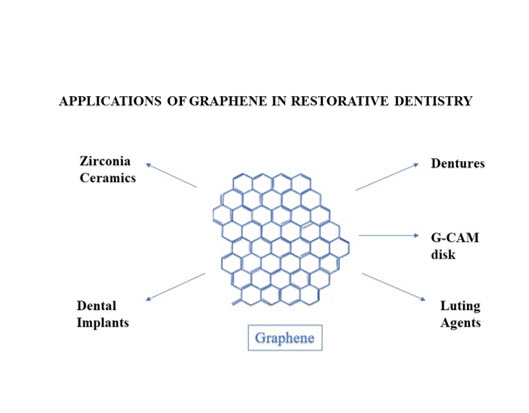
- Graphene and its nano-sized derivatives exhibit great versatility and peculiar properties.
- Graphene Nanoparticles are a potential antibacterial agent, and are highly effective in inhibiting the growth of dental pathogens.
- Increase in the modulus of rupture by174% by adding 2% Gr-Ag to the PMMA resin.
- The fracture toughness of raw zirconia ceramic is improved up to 175% by incorporating 0.09 wt% rGO.
- Graphene possesses an osteogenic property that enhances the expression of osteogenic genes like RUNX2, COL-I, and ALP, which boosts osteocalcin gene and protein expression, and consequently increases the deposition of mineralized matrix.
Abstract
(20818 Views) |
Full-Text (PDF)
(7167 Downloads)
|
Graphical Abstract
|
Reseach Highlights
Graphical Abstract:
Reseach Highlights:
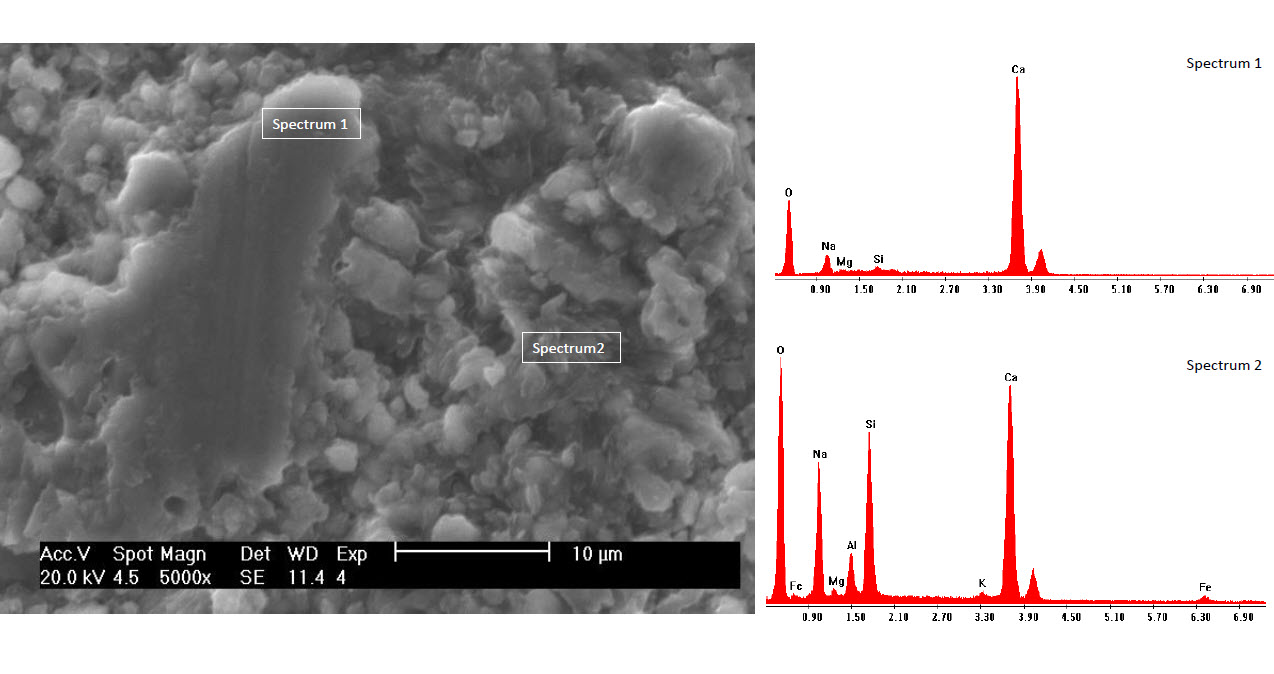
- Calcined bentonite clay is a perspective precursor for alkali-activated cement
- Alkali-activated cements formulations incorporated with high dosage of limestone were proposed
- Calcined bentonite was found to be compatible as a precursor for alkali-activated cement
Export as:
HTML
|
XML
|
RSS


 , Gabriel Viana Figueiredo