
Iranian Journal of Materials Science and Engineering
Iran University of Science & Technology
Fri, Oct 9, 2026
[Archive]


Volume 22, Issue 2 (JUNE 2025)
IJMSE 2025, 22(2): 66-77 |
Back to browse issues page



Download citation:
BibTeX | RIS | EndNote | Medlars | ProCite | Reference Manager | RefWorks
Send citation to:


BibTeX | RIS | EndNote | Medlars | ProCite | Reference Manager | RefWorks
Send citation to:
Rezaei Chekani A, naderi M, aliasgarian R, Safaei-Naeini Y. Fabrication, Microstructural Characterization, and Ablation Behavior of a Novel 3D Orthogonal Woven C/C-SiC-ZrB2 Composite Through I-CVI, SI, and LSI Combined Processes. IJMSE 2025; 22 (2) :66-77
URL: http://ijmse.iust.ac.ir/article-1-3880-en.html
URL: http://ijmse.iust.ac.ir/article-1-3880-en.html


Abstract: (21075 Views)
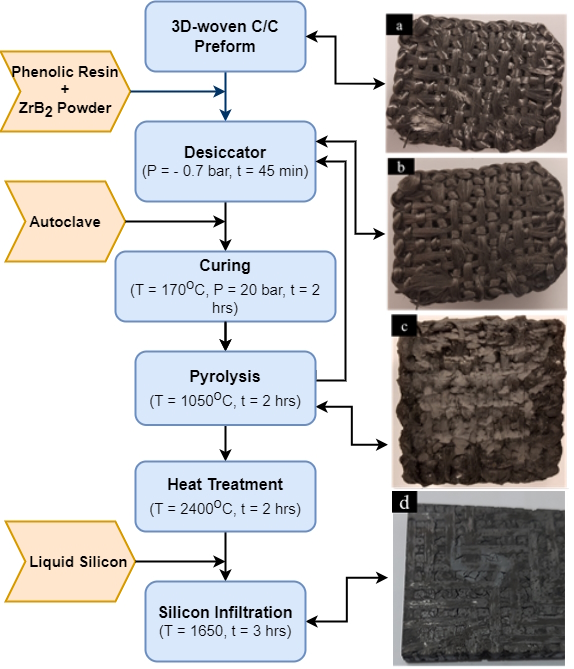
This paper presents the novel fabrication method of a three-dimensional orthogonally woven (3DW) C/C-SiC-ZrB2 composite and the effects of ZrB2 and SiC particles on microstructure and the ablation behavior of the C/C–SiC–ZrB2 composite are studied. C/C–SiC–ZrB2 composite was prepared by isothermal-chemical vapor infiltration (I-CVI), slurry infiltration (SI), and liquid silicon infiltration (LSI) combined process. Pyrolytic carbon (PyC) was first infused into the 3DW preform by I-CVI at 1050°C using CH4 as a precursor in order to form a C/C preform with porous media. The next step was graphitization at 2400°C for 1hr. Then ZrB2 was introduced into 3DW C/C preform with a void percentage of 48 by impregnating the mixture of ZrB2 and phenolic resin, followed by a pyrolysis step at 1050°C. A liquid Si alloy was infiltrated, at 1650 °C, into the 3DW C/C composites porous media containing the ZrB2 particles to form a SiC–ZrB2 matrix. An oxyacetylene torch flame was utilized to investigate The ablation behavior. ZrB2 particles, along with the SiC matrix situated between carbon fiber bundles, form a compact ZrO2-SiO2 layer. This layer acts as a barrier, restricting oxygen infiltration into the composite and reducing the erosion of carbon fibers. The findings were supported by FESEM imaging and further confirmed through x-ray diffraction and EDS analysis. The addition of ZrB2 to the C/C-SiC composite resulted in a lower mass and linear ablation rate; 2.20 mg/s and 1.4 µm/s respectively while those for C/C-SiC composite were 4.8 mg/s and 6.75 µm/s after ablation under an oxyacetylene flame (2500°C) for 120 s.
Keywords: three-dimensional orthogonal woven preform, liquid silicon infiltration, ceramic-matrix composite, C/C–SiC–ZrB2 composite, ablation resistance
Type of Study: Research Paper |
Subject:
Ceramic and glasses
Send email to the article author
| Rights and permissions | |
 |
This work is licensed under a Creative Commons Attribution-NonCommercial 4.0 International License. |
